
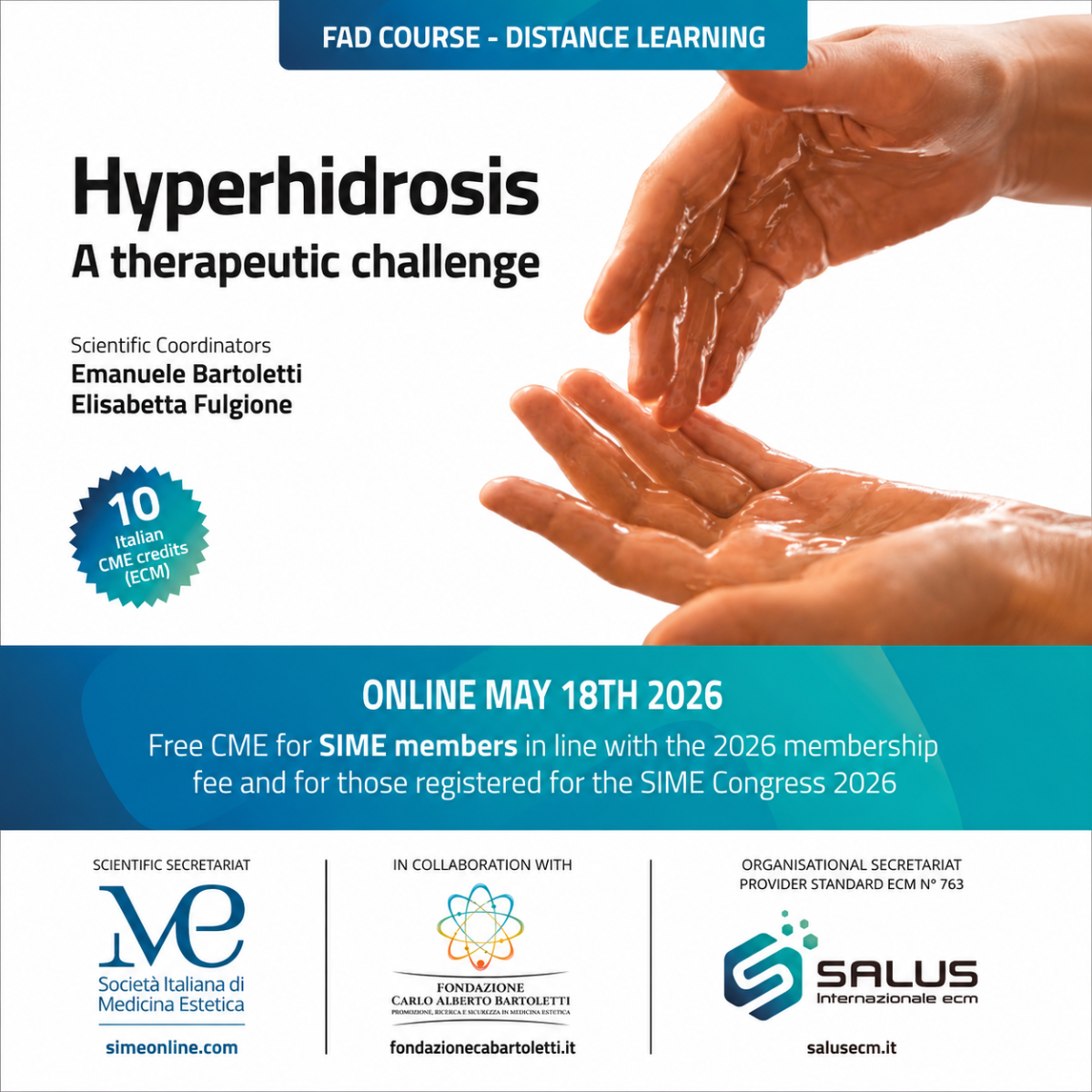
Description
Course Details
Educational Objective:
Technical and professional content (knowledge and competencies) specific to each profession, specialty, and subspecialty area, including rare diseases and gender medicine.
Scientific Rationale:
Hyperhidrosis is a chronic functional disorder characterized by altered regulation of the sympathetic nervous system, resulting in sweat production that is excessive relative to the physiological needs associated with thermoregulation. It is classified as primary (idiopathic) or secondary and affects approximately 1–3% of the population.
This condition negatively impacts those who suffer from it, creating emotional, psychological, and professional difficulties, and leading to a significant reduction in quality of life. Additionally, excessive sweating can often cause eczema and skin infections.
A proactive approach, based on targeted medical history, exclusion of secondary forms, and early knowledge and initiation of medical and surgical therapies, now allows the specialist physician to adequately treat hyperhidrosis and alleviate patient discomfort.
The aim of this FAD course is to refocus the aesthetic physician’s attention on this condition and to build familiarity with new therapeutic options recently authorized by AIFA for hyperhidrosis.
The course will first examine the pathophysiological mechanisms underlying the development of hyperhidrosis, as well as its epidemiological and clinical aspects, its impact on patients’ quality of life, and the various therapeutic options available.
The goal is to provide an overview of the clinical and therapeutic management of the condition in light of the main medical and systemic treatments currently available.
At the end of the course, the aesthetic physician will have acquired a comprehensive, 360-degree understanding of the condition and will be able to manage patients with hyperhidrosis more effectively, either independently or in collaboration with other specialists such as dermatologists and surgeons, including through knowledge of recently introduced active pharmaceutical agents.
MODULE 1
INTRODUCTION AND COURSE OBJECTIVES
Elisabetta Fulgione
Idiopathic focal hyperhidrosis: epidemiology and pathophysiology
Anna Balato
Psychological impact and effects on patients’ quality of life
Mariateresa Cantelli
Classification of idiopathic focal hyperhidrosis and clinical aspects
Giulia Briatico
Secondary hyperhidrosis: differential diagnosis
Stefania Guida
Qualitative and quantitative investigations useful for diagnostic and prognostic purposes
Eugenia Veronica Di Brizzi
Currently available topical therapeutic options
Ilaria Proietti
Currently available systemic therapeutic options
Giuseppe Alessandrini
In-depth scientific articles
MODULE 2
Injectable therapeutic options (live toxin demonstration)
Emanuele Bartoletti
Surgical therapeutic options
Enrico Davoli
Use of local anesthesia in the treatment of palmar and plantar hyperhidrosis with botulinum toxin
Vincenzo Landi
Rotational therapeutic approach and new treatment advances
Anna Campanati
In-depth scientific articles
CME ACCREDITATION
“The Hyperhidrosis: A Therapeutic challenge’’ made available on https://piattaforma.medexlearning.com/course/view.php?id=38 and organized by Med-Ex Learning is accredited by the European Accreditation Council for Continuing Medical Education (EACCME®) to provide the following CME activity for medical specialists.
The credits for the users of the module will be 0,5 European CME credit (ECMEC®) for every 30 minutes (30 minutes of actual e-learning excluding introductions etc.) of use, provided that the users have completed a module and have passed the relevant assessment.